
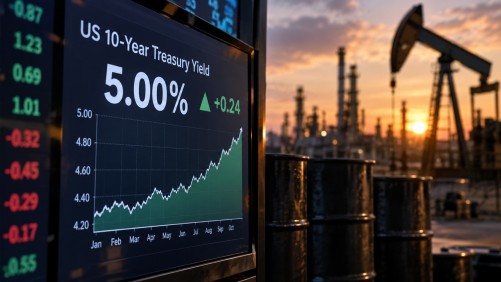
The cost of borrowing for the U.S. government has reached a significant milestone, with yields on the 10-year Treasury bond hitting 5% for the first time since 2023. This increase is part of a broader trend of rising yields in global bond markets, driven by escalating oil prices and heightened worries about inflation. Earlier this year, the yield was around 4%, but it has climbed steadily, particularly following the outbreak of the US-Israeli conflict with Iran in February. The last instance of yields surpassing the 5% threshold was in October 2023.
Brent crude oil prices have surged past $108 a barrel, following a series of attacks on Saudi Arabia’s energy infrastructure. This has intensified concerns about global oil supply disruptions. The closure of a major east-west crude pipeline in Saudi Arabia, due to drone attacks, and the involvement of Iran-aligned Houthi forces in escalating tensions, have contributed to the volatility. Additionally, talks with Tehran regarding a temporary shipping route through the Strait of Hormuz have been postponed by Gulf states, adding further uncertainty. The Strait of Hormuz is a critical passageway for a substantial portion of the world’s oil and gas supplies.
The rise in energy prices is compounding inflationary pressures and creating uncertainty around future interest rate decisions. Market participants are closely monitoring the upcoming interest-rate decision from the U.S. Federal Reserve, as well as the Bank of England’s announcement expected later this week. The significance of the 10-year Treasury yield increase lies in its role as a benchmark for global borrowing costs, affecting financing for governments, businesses, and households worldwide.
European bond yields have also climbed, with UK’s long-term government borrowing costs reaching unprecedented levels in decades. The ongoing rise in energy prices, coupled with renewed geopolitical tensions, has fueled concerns that central banks may need to uphold tighter monetary policies for an extended period. This environment mirrors earlier fluctuations in oil prices, where Brent crude surged from $72 a barrel before the conflict to a peak of $126 in April, followed by a summer decline amid hopes for a ceasefire. Prices, however, have rebounded as hostilities resumed and diplomatic negotiations stalled.
As oil prices once again exceed $100 a barrel, markets are grappling with heightened concerns over inflation, interest rates, and the broader implications of prolonged disruptions in global energy and trade routes. This challenging economic backdrop underscores the complex interplay between geopolitical developments, energy markets, and financial stability.