
Thailand’s ambitious solar initiatives are set to significantly impact household electricity costs and the development of a domestic clean-energy supply chain. As part of a new household solar installation program, the government plans to provide subsidies of approximately THB50,000 per household, targeting initially one million homes with the potential to expand to 1.5 million. This move aims to encourage both rooftop and ground-mounted solar installations across the country.
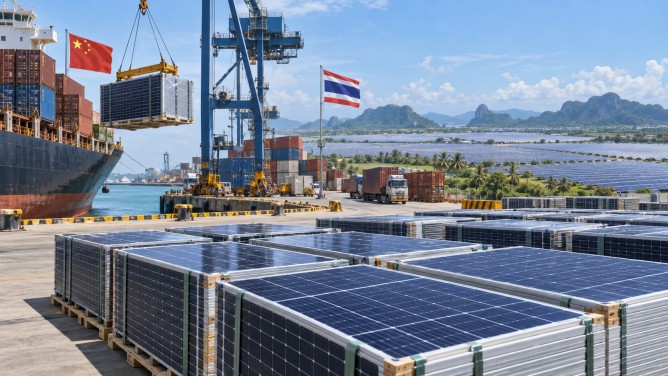
The surge in solar panel imports underscores the scale of Thailand’s renewable energy ambitions. From January to July 2026, the country’s solar panel imports rocketed by 88.7% year on year, reaching a total of US$426.7 million. The vast majority of these imports, accounting for 99.3%, originated from China, with Chinese imports alone rising by 107.1% to US$423.9 million, according to data from Thailand’s Ministry of Commerce and Customs Department.
Although Singapore and Hong Kong also contributed to Thailand’s solar panel imports, their share remained minimal, each representing around 0.3% of the total import value. This highlights China’s dominant role in supplying solar panels to Thailand, a trend likely driven by the cost-effectiveness and availability of Chinese products.
To complement the import strategy, Thailand is also exploring ways to bolster its domestic solar manufacturing capabilities. Government officials are collaborating with the Ministry of Labour to enhance the skills of workers in solar panel assembly, installation, and maintenance. Furthermore, discussions with the Board of Investment are underway to consider reducing duties on production inputs that are not readily available within the country, thereby incentivizing local production.
These developments are part of Thailand’s broader strategy to reduce reliance on non-renewable energy sources and foster a sustainable energy future. By developing a robust domestic clean-energy supply chain, the country hopes to not only cut household electricity costs but also position itself as a leader in renewable energy in the region.